Tippy Taps 101: The Basics
During the most recent assessment trip to Apatut in November 2014, the teachers at the community’s elementary school requested a Tippy Tap for student and faculty use. A Tippy Tap functions as a sink in places where running water may not be available. Therefore, in lieu of a sink, a Tippy Tap is essential for promoting proper hygiene and reducing the rate of illness such as chronic diarrhea and even pneumonia. Tippy Taps are incredibly easy to make and require very few construction materials, leading to proven success in developing areas worldwide. Speaking from personal experience, they are also very fun to use! By installing one at the school, our team and the supporting professors at Apatut Elementary School hope to reinforce essential hygiene skills to the children who will, in turn, spread the information to the rest of the community, perhaps even building their own. This will lead to a healthier (and happier) community!
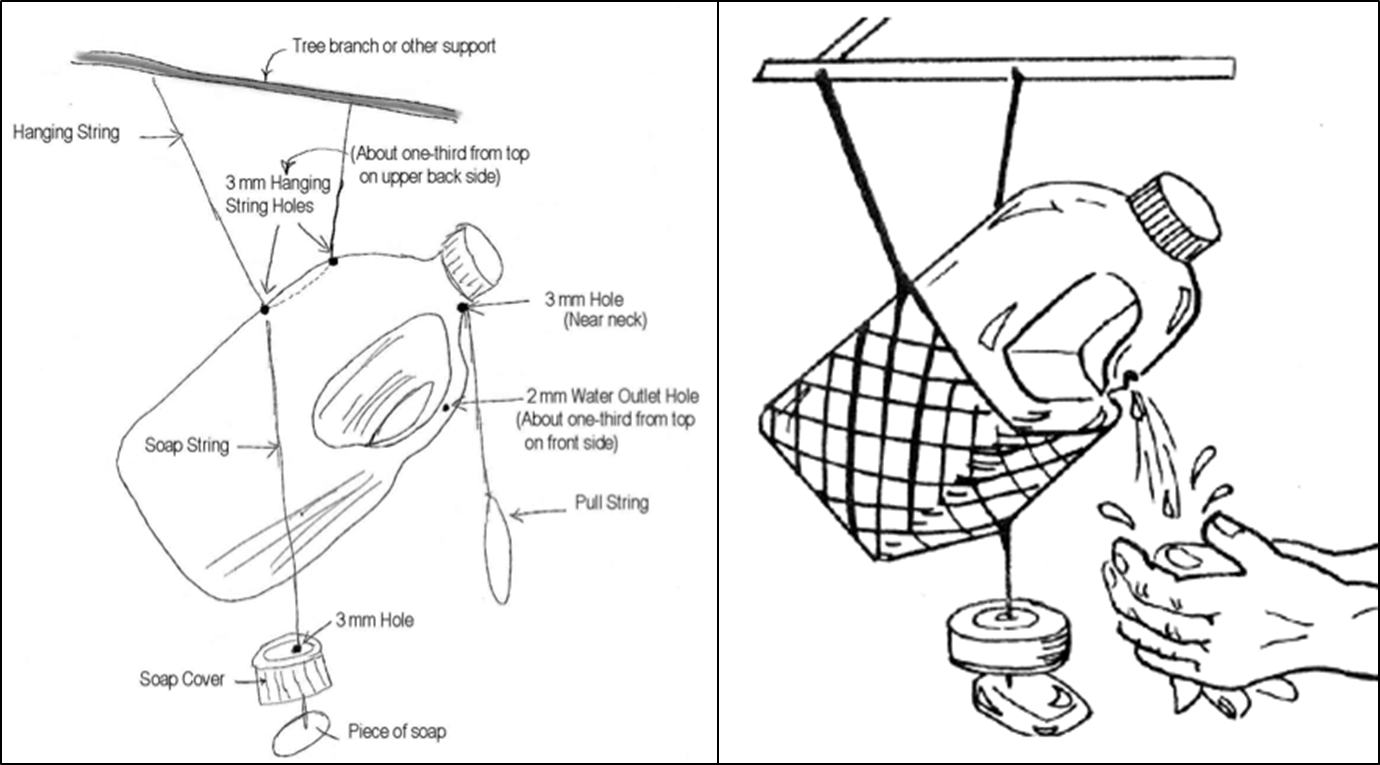
There are variety of methods to design Tippy Taps but they all essentially boil down to the same basic supplies: four sticks, a Jerry can, string, rocks, something sharp to poke holes with, a shovel, a bar of soap, and water. Once completed, the Jerry can is supported by a stick, held up by two other sticks. A piece of string is tied around the neck of the Jerry can and attached to a separate stick on ground, this stick acts as a foot pedal. When someone steps on the stick on the ground, the string pulls the Jerry can down and allows water to flow out of the can (similar to faucet!). The foot pedal is extremely important because it eliminates the need to touch the water and the can, preventing contamination from dirty hands. Next to the can is a bar of soap attached to the same stick by a string. The hanging soap is long enough to reach under the flowing water allowing users to wash their hands, yet does not touch the ground. Under the flow of water is some sort of gravel which prevents the ground from getting muddy and becoming a breeding ground for mosquitos. When the Jerry can runs out of water it can be refilled and put back in service immediately!
There are variety of methods to design Tippy Taps but they all essentially boil down to the same basic supplies: four sticks, a Jerry can, string, rocks, something sharp to poke holes with, a shovel, a bar of soap, and water. Once completed, the Jerry can is supported by a stick, held up by two other sticks. A piece of string is tied around the neck of the Jerry can and attached to a separate stick on ground, this stick acts as a foot pedal. When someone steps on the stick on the ground, the string pulls the Jerry can down and allows water to flow out of the can (similar to faucet!). The foot pedal is extremely important because it eliminates the need to touch the water and the can, preventing contamination from dirty hands. Next to the can is a bar of soap attached to the same stick by a string. The hanging soap is long enough to reach under the flowing water allowing users to wash their hands, yet does not touch the ground. Under the flow of water is some sort of gravel which prevents the ground from getting muddy and becoming a breeding ground for mosquitos. When the Jerry can runs out of water it can be refilled and put back in service immediately!
Below are some pictures of Tippy Taps I used in India, along with some instructional diagrams from sources such as the CDC depicting different construction methods. Currently, EWB- Philadelphia is working on constructing a pilot Tippy Tap model of our own to ascertain the best construction method. We plan to construct one on our next trip in April 2015 by working with community members of all ages, and in the process of team-building, continue laying the foundation for a strong working relationship within Apatut.
 |
| Sources: CDC “Tippy Taps” / Lifewater International “Tippy Tap II” |
 |
| Tippy Taps in India (Photographer: Melissa Shinbein) |
*****